

In Defense of Temporary Obsessions

In a world that wants mastery or monetisation as the outcome of every fleeting interest, temporary obsessions are little rebellions. Their purpose is to restore order in the playground that is your life.
The yellow ukulele that has become home decor, the vintage film camera you’re looking to resell, or the six-day streak abandoned on the language app might guilt you into never picking another hobby again.
As it happens, one day, I suddenly got obsessed with painting. I went to this quaint art shop near my house and bought the widest range of acrylic colors I could find, a full set of paintbrushes, and three canvases of varying sizes—all of the best quality. I studied color theory, devoured tutorials on brushstrokes, filled pages with messy swatches that meant nothing to anyone but me. First came a Vermillion red pomegranate against Prussian blue, then my cat Kiki in greige. I was building momentum until one misplaced stroke gave my Flycatcher an absurd Pinocchio beak. Then, I no longer wanted to paint. The colors went into the drawer, where lay a stack of origami sheets and a wooden chessboard, all of which I return to occasionally without commitment.
Yet, my argument is that every temporary obsession is not some certificate of disloyalty. Some are reminders of our troubled relationship with failure. But all are imprints of our curiosity, evidence that we once let ourselves fall in love deeply with something new and wildly outside of our comfort zone.I think of small pockets of deep attention that lead to no “socially recognised outcomes” as time snacks. Minutes or hours spent exploring something random, savouring fully the deep end of time, munching on the raw texture of attention, no care for the calorie or for that matter, the protein count.
Temporary obsessions are always timely. They arrive after a heartbreak, during a career crisis, in grief.
They're like the divemaster when someone's narking. I learnt recently about this phenomenon. When divers descend beyond a certain depth into the ocean, nitrogen buildup in the bloodstream can cause narcosis, a state of dreamlike disorientation. A diver may feel euphoric, detached, even compelled to keep sinking. It’s the divemaster’s job to notice, to gently bring them up, help them clear their head, often against their own perception of reality.
Temporary obsessions are like this, pulling you by your arms when you're narking into the abyss of a particular emotion. The rhythmic movement of needles on wool. The attention to breath in yoga. The wet clay between fingers. The math of turning yeast into sourdough. They return you to the body, to sensation, to the present. Their job isn't to stop the descent into grief or sadness, but to make one conscious of it. They are the tap on the shoulder by the divemaster, the pull towards the surface when we've forgotten which way is up.Temporary obsessions leave behind a residue of attention—a way of seeing that remains even when the practice doesn't.
They also leave behind a register of new words and concepts. New metaphors to perceive the world, to make sense of it. Origami teaches me that the mind is like paper, always carrying creases no matter how many times I smooth out a memory. I learned from birding that seeing is not what the eyes notice alone, but seeing is also listening, observing movement, and understanding habitat. The time I spent reading about astronomy or watching hour-long lectures on YouTube wasn’t exactly a waste. When I try to explain a complex feeling, the language of wormholes rises to the surface, offering itself as the perfect metaphor.
Even Ada Lovelace practised this. While history remembers her as the first computer programmer, she explored music, languages, and metaphysics with equal intensity. In her famous notes about the Analytical Engine, she wrote that machines might one day create art and music, not just crunch numbers. She drew this connection by observing how punch cards controlled pattern-weaving in Jacquard looms, realizing the same principle could allow numbers to represent anything, not just quantities. This kind of interdisciplinary approach was the foundation of her thinking, which she called "poetical science”.We scorn the dilettante and dismiss the amateur, but these are their origins: dilettante from the Italian "dilettare" which means to take delight and amateur from the Latin "amator" which means lover.
Some temporary obsessions have also returned to me when deepening relationships. The origami cranes I folded to forge trust with my niece. The birds I pointed with a new friend on our walk together. All those Punjabi folk songs memorised in my teens arrived on my lips when I had to break the ice with R's family. I didn't know their language, but I knew songs in their language.
And so, I truly, truly believe this:
"In the beginner’s mind there are many possibilities, but in the expert’s there are few" - Shunryu Suzuki.
With each new fascination, we return to that state of wide-eyed curiosity where there are many possibilities. We ask naive questions. We make unexpected connections. We don't yet know which rules matter and which can be broken. Our new devotions keep us humble, pliable, in conversation with wonder.And lastly, these obsessions aren’t distractions from something more “real” out there, they are what’s real. So the next time you find yourself inexplicably drawn to analyzing one-shot techniques in films at 2 AM or spending an entire weekend learning to make the perfect dumpling, don't resist. Return to the playground that is your life.

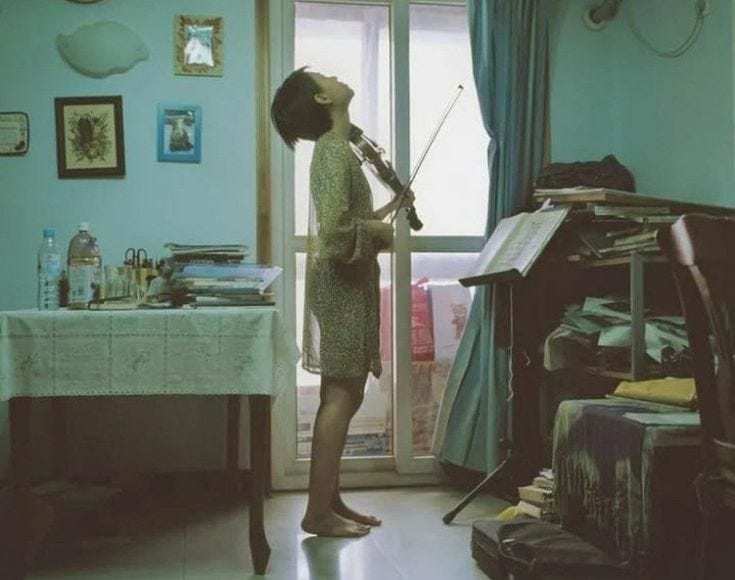
image from Bees by Chen Zee

This is one of my favourite essays ever
This is so true and important! Thank you for putting it into words so beautifully.